From stone to memory, from engineering to identity, until he reached that more elusive dimension which, towards the end, he would call the soul. It is worth following his reflections almost in their entirety, because his argument unfolds through images, digressions and references that at first seem to lead us away from the earthquake, only to return to it each time from a different perspective. La Porta began by describing the book as “a narrative, or rather an accurate account of an urban reconstruction”, adding that it was “more compelling than many contemporary novels and crime stories” he reads, as he pointed out with his customary irony, for professional reasons. Here, he said, “the epic does not come from books or imagination, but from lived experience, from a battle that was actually fought.” Almost in passing, he added that perhaps it was no coincidence that much of The Name of the Rose was filmed in the countryside surrounding L’Aquila. At the beginning of the book there is a quotation from Calvino: “The city does not tell its past, but contains it like the lines of a hand.” La Porta takes that image and turns it into something close to a key for reading the entire book. Antonello Ricotti, he observes, did not simply record L’Aquila’s past, almost bureaucratically. He “deciphered” it. He “reinterpreted” it. “He is not an archivist but a palm reader. He knew how to read the lines of the hand.”

The image of the palm reader struck me as particularly beautiful, perhaps because at first glance it seems so far removed from the world of engineering. A palm reader looks at visible signs in search of something that cannot be seen: a story, a direction, perhaps even a destiny. And already, as I listened to him, reconstruction was beginning to seem like something very different from simply rebuilding what had been destroyed.
To rebuild cannot mean merely to recreate.
La Porta insisted on the need to allow a city to “speak”, even when it is being replicated or rebuilt, and at this point introduced a seemingly unexpected comparison: America. He spoke of travelling through American cities and repeatedly encountering copies and reinterpretations of famous European churches and monuments. “One thing is the Eiffel Tower in Las Vegas or the Parthenon in Nashville,” which belong more to the world of Disneyland. Quite another are “the neoclassical buildings of Washington”, the White House inspired by Palladian villas, the Capitol recalling St Paul’s Cathedral in London, the Supreme Court drawing on the Corinthian temple, Union Station echoing the Basilica of Maxentius. Yet, La Porta argues, this is not simply a collection of architectural theme parks. “America is the active museum of Europe also because it knew how to refound it” and, beginning with its own revolution, “breathed new life into the old and dusty European humanism.”
The difference lies precisely here. We can reproduce a form perfectly and create something lifeless. Or we can preserve an ancient form while allowing it to continue living.
And so the reconstruction of L’Aquila ceases to be merely a matter of buildings. It becomes a question of the relationship between matter and memory, permanence and transformation. Ultimately, it becomes a question of identity. La Porta introduces another powerful image: “Restoring identity to a city is like restoring it to a person.”
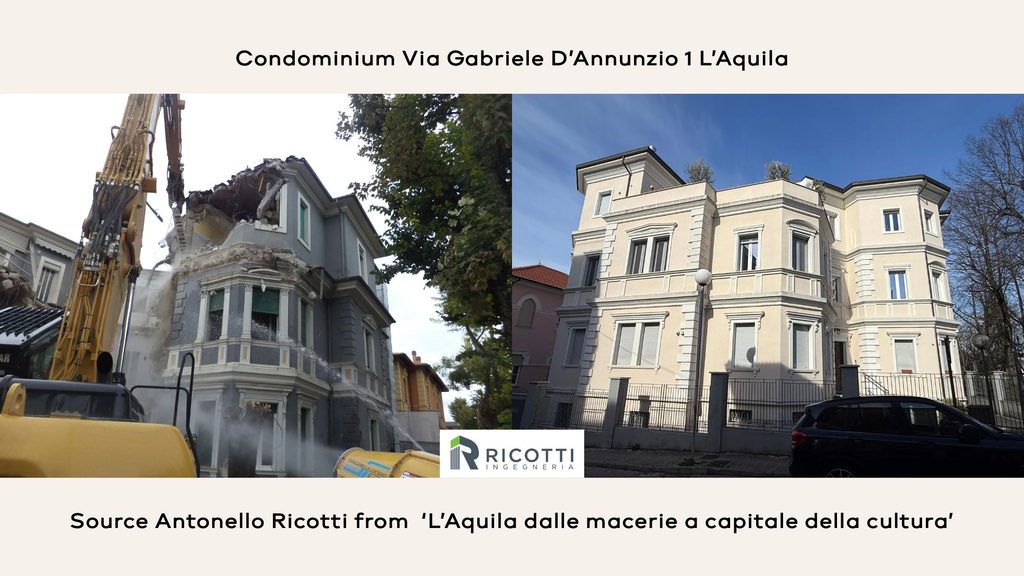
He then builds what is almost a small parable of memory. “If someone suffers a stroke, the equivalent of an earthquake, and loses their memory, they no longer possess a unified sense of their own life. We must help them recreate that memory, piecing together fragments and remnants of what they have lived.” But there is a limit to what can be restored from the outside. “Eventually, they must rediscover it themselves.”
La Porta immediately brings the image back to L’Aquila. “Antonello and his team have done everything they could. Now the responsibility passes to the people of L’Aquila.” Because “only they will know how to restore identity to their city”, and they will do so by living it, inhabiting its old and new spaces, returning to its shops and cafés, weaving the trauma back into everyday life, relationships and human exchange. The engineers were therefore entrusted with an immense task, but not an omnipotent one. Antonello, La Porta says, “simply gave them back a frame, the best frame possible, a stage with an ancient heart.”
As I listened, I resisted the temptation to anticipate where he was going. His reflections were still moving between matter and everything within matter that cannot be seen.
The comparison La Porta draws with Gibellina becomes particularly interesting here. “There, the city was moved and rebuilt elsewhere. Here, instead, the choice was urban continuity,
permanence.” These decisions, he points out, are inevitably shaped by geography, landscape and the extent of the earthquake damage, and therefore “cannot be made in advance, on paper.” His conclusion is unequivocal: “L’Aquila could not have been moved.” What stayed with me most was that word: permanence. Remaining in the same place even though that place has been wounded. Not erasing the rupture. Absorbing it.
There is also a technical vocabulary in Antonello’s writing that La Porta observes with amused critical attention. Antonello writes that, at the moment of the devastating earthquake, he managed to maintain “an appropriate level of control and operational clarity.” La Porta’s response is immediate: “A humanist would never express himself like that.” Yet within this “technical and scientific language” he senses an attempt to “cool” an emotion that might otherwise have become overwhelming. He pauses over another expression, Antonello’s description of preserving the historic sedime of Onna, a technical term referring to the original footprint of the settlement. “That word, sedime, from the technical language of construction, would have delighted Gadda,” La Porta observes, because an apparently dry and specialist term suddenly reveals an unexpected expressive power.
This passage also seemed important to me because it shows that La Porta had read not only the story Antonello tells, but the very language through which he chose to tell it. Technical language becomes a kind of embankment, a structure built around emotion so that emotion does not overwhelm everything.
And then comes beauty.
“Antonello’s reconstruction is clearly culture, but not only that,” La Porta says. “I would add that it is a work of art because it has created beauty.” Here he turns to Carlo Levi, for whom “beauty is a way of being, it coincides with civilisation”, rather than with mere aestheticism.
And from there comes a thought that once again expands the discussion from the city to the lives lived within it: “If we live in beautiful places, we are encouraged to behave well and civilly.” It is almost a provocative statement today, accustomed as we are to thinking of beauty as a luxury, an ornament, something that comes after the serious things. Here, instead, beauty recovers a civic purpose. It does not decorate life. It gives life a form.
And finally comes the most difficult word of all: soul.
“Ultimately, we are speaking here of ‘soul’,” La Porta says, “a concept we cannot leave solely to believers.” He immediately offers a definition that, to me, contains the destination of his entire reflection: “The soul of a city is that invisible, intangible dimension which nevertheless gives meaning to everything else.” Where does it come from? “It is created by many things: architecture, topography, atmosphere, light…” Material and immaterial things together. Or perhaps that mysterious threshold where matter, arranged in a particular way, begins to mean something. It was at this point that, for me, his reflection on reconstruction inevitably became metaphysical, without becoming religious. Because if a city possesses a soul, then rebuilding cannot simply mean saving its walls. It means making possible once again the manifestation of something that is not materially contained within those walls and yet, without those walls, those streets, that light and those human relationships, might no longer be able to reveal itself. La Porta concludes by returning to his original intuition, closing the circle: “Antonello made the invisible visible.” That, he reminds us, was precisely the task of the artist according to Paul Klee. And so: “I began by saying that he is not merely a civil engineer but a palm reader. I will end by saying that he is also an artist.”
And it is here that Filippo La Porta’s words met a question that has accompanied me for a long time: What are we really rebuilding when we rebuild?
Matter, certainly. But perhaps matter is only the visible part of a much deeper process. A façade can be restored. A road reopened. A stone placed back exactly where it once stood. And yet none of these things, by themselves, can restore what was lost. Because what we recognise as the identity of a place, or of a person, does not reside entirely within its material components. It is something closer to an invisible continuity running through matter, memory and time. And when that continuity is broken, it must find a new form through which it can manifest itself again.
Perhaps this is the difference between reconstruction and replication. A replica tries to reproduce what once existed. True reconstruction accepts that something has happened, and that what happened has forever changed what comes afterwards. It does not erase the wound, but neither does it allow the wound to become the only possible definition of what remains. It weaves it into a new form of continuity.
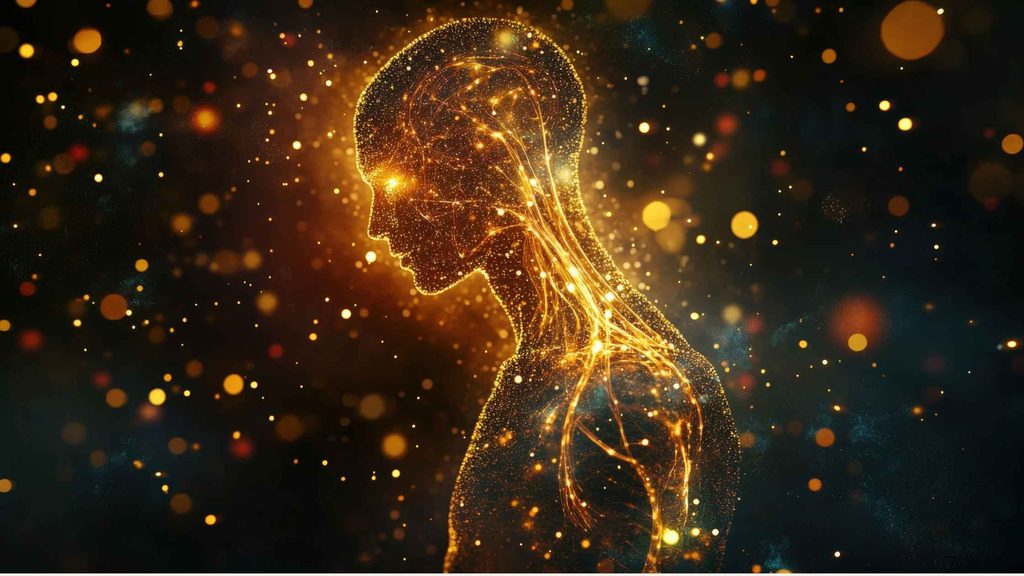
This is why rebirth has never seemed to me to mean going back. We never truly return to what we were. Perhaps we should not even wish to. To be reborn is to preserve some essence of ourselves while passing through transformation.
Something remains. Something is inevitably lost. And something else appears for the first time.
Identity and change, seemingly opposed, become part of the same movement. I had encountered this thought before, in another form, while writing The Vermilion Bridge: the idea
that a fracture does not necessarily need to be erased for continuity to exist. Instead, the fracture itself can become the place of passage, the point at which what has been and
what does not yet exist are given the possibility of meeting.
Perhaps this is also why I was so struck by La Porta’s use of the word “soul”. If the soul is that “invisible, intangible dimension which nevertheless gives meaning to everything else”, then it cannot coincide with what can be physically destroyed and rebuilt. And yet it still needs matter in order to become present. It needs architecture, light, streets, everyday gestures, people returning to inhabit a place. The invisible, then, is not the opposite of the visible. It is what becomes manifest through it.
And perhaps rebuilding means precisely creating the conditions for that to happen once again. Stones are visible. Scaffolding is visible. Calculations, plans, even cracks can be measured. But the reason we rebuild is not. Identity. Memory. Belonging. Continuity. That part of a place that
survives its physical form and yet needs a form in order to exist again.
An earthquake can destroy matter in seconds. Physical reconstruction takes years. The reconstruction of the invisible belongs to another kind of time, perhaps because it is not about restoring what once was, but allowing what remains to transform without entirely losing itself.
It is there, I think, that reconstruction and rebirth finally become the same thing. Not in returning to before, but in life’s mysterious ability to preserve continuity through discontinuity. To transform loss without denying it. To allow something invisible to emerge through what can be seen.
Or, to return to Klee and to Filippo La Porta’s final words:to make the invisible visible.
A final reflection
Perhaps it is precisely here, in that idea of “making the invisible visible”, evoked by Filippo through the words of Klee, that the meaning of reconstruction begins, almost naturally, to extend beyond the boundaries of a city. Because cities are not the only things shaken by earthquakes. And stones are not the only things that can break. There are fractures that belong to life itself, sudden passages after which what we knew no longer exists in quite the same form. And then rebuilding becomes something far subtler than attempting
to restore what was. It becomes the way we search for continuity between who we once were and who, through that fracture, we have become.
I think of kintsugi, the Japanese art of repairing broken ceramics with lacquer and gold, not attempting to conceal the lines of fracture, but leaving them visible, even allowing them to become part of the object’s beauty. It is an image that has always fascinated me because it suggests something far beyond simply putting the broken pieces back together. What has been broken is not returned to its previous condition. Its history is not erased in pursuit of some recovered perfection. The fractures remain, traced in gold, bearing witness to what happened while becoming, at the same time, part of a new form.

Perhaps our own soul rebuilds itself in much the same way.Not by going backwards. Not by erasing our wounds. Not even by trying to become again who we were before something happened.
But by allowing those scars to enter the fabric of our identity, because they too, for better or worse, tell the story of the road we have travelled. To rebuild, then, is to rediscover something we still recognise as our own without denying the transformation. To preserve memory without becoming its prisoner. To leave space for a beauty that is born not from the absence of fractures, but from our ability to hold them within a new form. And perhaps this is as true for L’Aquila as it is for each of us. We can rediscover an identity without erasing our history.
Perhaps the opposite is true. Perhaps genuine rebirth becomes possible only when that history is acknowledged in its entirety, with its losses, its discontinuities and its scars, until we discover that some of the lines we once believed had broken us have, with time, become the fine veins of gold through which we have learned to recognise ourselves.
Here you can listen to Filippo La Porta’s talk